Kyosai 共済 (The MEXT Mutual Aid Association 文部科学省国家公務員共済員組合) for University of Tokyo Employees
Joining a health insurance program is mandatory if your visa period of stay on your foreign resident registration is more than one year. Those who have the employment contract with the University of Tokyo automatically join a welfare program package called Mutual Society of Health Insurance ("Kyosai") run by the Ministry of Education, Culture, Sports, Science and Technology (MEXT) for its employees. Kyosai is not just a health insurance system but a package of various benefits. You must pay premiums from the day of appointment, but as a return begin to receive benefits when you get sick or injured, have a baby, are hospitalized, take medical leave beyond quota, meet a natural disaster, or die.
For greater information, please refer Kyosai web site. www.monkakyosai.or.jp/en/short/index.html
Monthly Premium
For the MEXT Kyosai, the insurance premium is equally split between the employee and the employer. Your share, which is 4.047% of your "standard monthly remuneration", is deducted from your monthly salary, together with an additional 0.868% for "elderly assistance" (if you are older than 40) as "short-term premium".
MEXT Kyosai covers 70% of the medical and dental cost including prescribed medications, and the remaining 30% is handled by the patient. This share is also 30% for your dependent family members.
It may sound high, but you should note that the medical costs in Japan are relatively low as long as you receive standard treatments. According to a study by the AIU insurance company in 2005, an appendicitis operation costs 2 million yen in New York, 0.9 million yen in Paris, and 0.4 million yen in Tokyo (*1). The MEXT Kyosai also has a subsidizing program for excessive medical cost. A part of your medical payment will be returned to you if your total medical cost within a single month exceeds a certain amount. This amount depends on your income, but it is safe to assume that the maximum payment in one month per incident will not exceed 25,000 yen (Standard Monthly Salary is 500,000 or less) and 50,000yen (SMS is 530,000 or more) as long as you receive standard treatment.
(*1) Reference: http://www.med.or.jp/nichinews/n170620l.html
Health Insurance Card
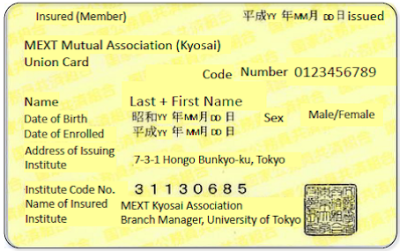
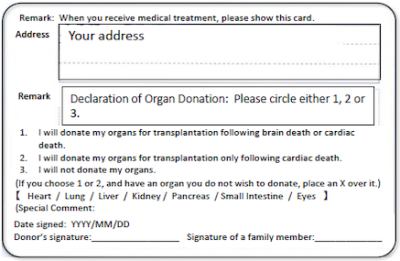
A health insurance card will be issued to you when you join MEXT Kyosai or Kokuho (see next section). Do not forget to bring it with you whenever you visit a hospital or doctor's office. Note that normal pregnancy and childbirth, health examinations, and the use of private hospital rooms, are not covered by these insurance programs. There are also some rules on the types of treatments that are covered. For instance, metal crowns of the teeth are covered, but aesthetically appealing crowns with natural tooth colors are not. If the treatment you seek is not covered by the insurance, you will be informed before the treatment is begun.
Claim for medical treatment abroad
You can request reimbursement from Kyosai or Kokuho health insurance systems for the medical expenses that you paid while traveling abroad. However, the amount is based on the standard in Japan, so that you should expect that actual amount you receive is less than the full amount in most cases.
Please make sure that you print out the necessary forms below and bring them with you to the clinic/hospital. They are written in both English and Japanese so that they can be completed by attending physicians.
Attending Physician's Statement (pdf) (Duplex printing if possible)
Itemized Receipt for Hospital/Clinic (pdf) (Duplex printing if possible)
Attending Dentist's Statement (pdf)
Itemized Receipt for Dentist (pdf)
Here is a list you will be required to submit if you claim a medical cost you had while abroad.
1. Attending Physician (or Dentist for dental treatment)'s Statement: This should be printed, brought, completed, and signed by the attending physician.
2. Itemized Receipt (for both Physician and Dentist): This also should be printed, brought, completed, and signed by the attending physician or the superintendent of hospital/clinic.
3. Original Receipt: Issued by the hospital/clinic attached with Japanese translation
4. Claim form for the Medical Treatment: This form will be prepared by Administrative staff after you return from abroad.
5. Request for deposit to your bank account: This will be prepared by Administrative staff after you return from abroad. Kyosai will make a wire transfer to your designated bank account in Japan.
You must bear the cost of any additional and optional travel insurance even for a business trip. Note that some credit cards offer travel insurance coverage for your foreign travel.
You may refer the Ministry of Health, Labour and Welfare website.
http://www.mhlw.go.jp/english/
Dependents
In the case that the insured employee (Kyosai member) supports dependents, the dependents are eligible for coverage under the Kyosai health insurance plan. However, the dependent’s annual salary has to be 1,300,000yen or less. Once average of the dependents’ salary in any three months exceeds 108,000yen (including allowance), the dependents lose eligibility. The term “dependents” included the spouse, parents, grandparents, great-grandparents, children, grandchildren, or siblings of the member.
If there is a change in the status for any dependents (birth, death, employment status, residence), you must inform Team IPMU immediately. In order to approve as an eligible dependent, you are required to submit documents attesting to his/her receipt of financial support from you. Please ask Team IPMU what documents need to be submitted.
Your monthly premium doesn’t change no matter how many dependents you have.
National Health Insurance (国民健康保険)
For those with a postdoctoral appointment, which health insurance program you will join varies depending on the source of your salary. Some may join National Health Insurance ("Kokuho", for self-employed or retired people who are not covered by corporate or government insurance programs). In this case, you must make the necessary arrangements at the city hall in the area of your residence. IPMU will assist you in this. For details, please consult our office. For Kokuho, your premium depends on your previous year's income. Please inquire at the city hall for more details.
Kokuho also covers 70% of the medical and dental cost including prescribed medications, and the remaining 30% is borne by the patient. This share is also 30% for your dependent family members. A health insurance card will be issued to you as well when you join Kokuho.