
August 6, 2026
The University of Tokyo Kavli Institute for the Physics and Mathematics of the Universe (Kavli IPMU, WPI)
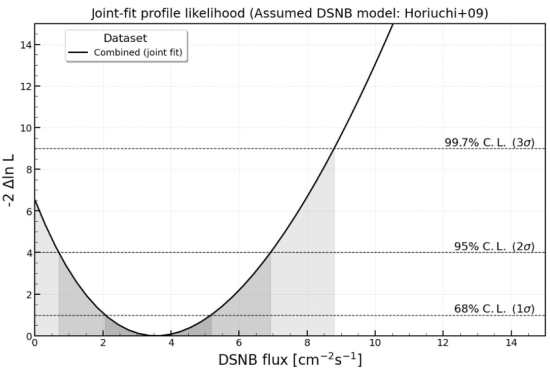
The first ever indication of the Diffuse Supernova Neutrino Background (DSNB) at a significance level of 2.6 sigma (99.5% confidence level) has been uncovered according to results presented by the Super-Kamiokande Collaboration at Neutrino 2026: XXXII International Conference on Neutrino Physics and Astrophysics on June 25 in Irvine, California, USA.
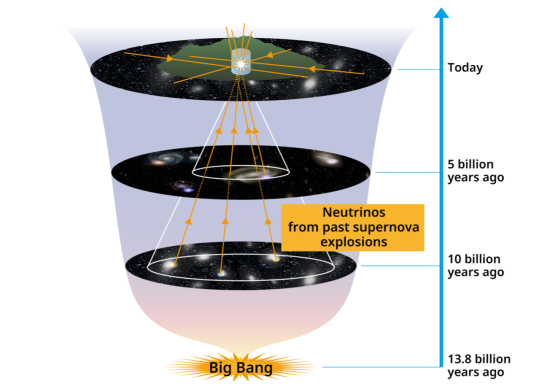
The DSNB is the integrated flux of neutrinos originating from all core-collapse supernovae throughout cosmic history. When a massive star explodes at the end of its life, it releases enormous amounts of energy in the form of neutrinos, as well as producing and distributing all the complex chemical elements needed for life including carbon, oxygen, nitrogen, and iron.
Studying the DSNB would deepen researchers understanding of the history of cosmic star formation and nucleosynthesis, but it has been challenging since neutrinos from these explosions, particularly in the early universe, are extremely elusive and difficult to detect. Almost like a “faint whisper” according to some researchers.
Back in February of 1987, Super-Kamiokande’s predecessor detector, Kamiokande, succeeded in the direct observation of neutrinos from a single supernova (SN 1987A). However, detecting the much more subtle DSNB flux has remained a long-standing challenge for Super-Kamiokande.
Several researchers from the University of Tokyo Kavli Institute for the Physics and Mathematics of the Universe (Kavli IPMU, WPI) have been part of the Super-Kamiokande Collaboration and have significantly contributed to making this DSNB observation possible, including Professor Mark Vagins, Associate Professor Kai Martens, Assistant Project Professor Patrick de Perio, Project Researchers Andrew Santos and Lluis Marti, and graduate student Saki Fujita, who additionally won a “Best Poster” award at Neutrino 2026 for her machine learning-based DSNB analysis techniques and results.
“Over twenty years after first proposing a way to enable Super-Kamiokande to detect the DSNB, it is very exciting to finally see these promising results,” said Vagins, who has led the project to enrich Super-Kamiokande with gadolinium at Kavli IPMU since 2008. He is the co-inventor of the gadolinium-in-water concept, along with his theorist colleague, Ohio State University Professor John Beacom. They first published their ideas (and introduced the term “DSNB”) in a 2004 Physical Review Letters article. “The DSNB provides a unique way to peer back in time to the very beginning of stellar formation, and it also carries information from places in the universe – namely the incredibly hot and dense interiors of ancient exploding stars – that are impossible to examine in any other way,” continued Vagins.
The new result was obtained through a detailed analysis of approximately 5,000 days of observational data, combining the pure-water operation period (3,349 days between 2008 and 2020) and the gadolinium-loaded period (1,653 days from 2020 to the present).
After removing background noise, primarily atmospheric neutrino events and spallation events involving oxygen nuclei in water induced by cosmic rays, the researchers identified a statistically significant excess signal in the neutrino energy range from 13.3 to 81.3 MeV.
The result does not yet meet the discovery threshold (5 sigma or higher) and is therefore currently described as an indication rather than a definitive detection, but its estimated DSNB flux of 3.6 ± 1.6 cm⁻² s⁻¹ is consistent with the range predicted by several theoretical models.
More data accumulation and further analysis improvements will be necessary for a definitive detection, which the collaboration is continuing to work on using Super-Kamiokande and its currently under construction successor, Hyper-Kamiokande.