
March 5, 2026
The University of Tokyo Kavli Institute for the Physics and Mathematics of the Universe (Kavli IPMU, WPI)
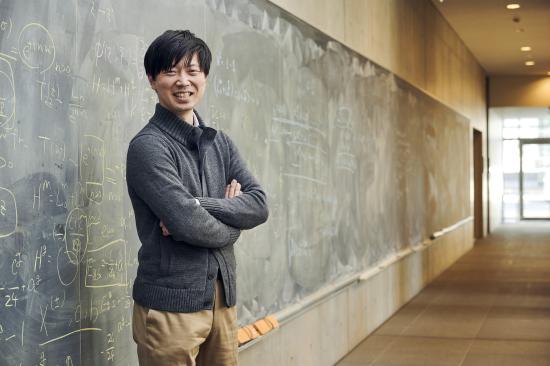
Waseda Institute for Advanced Study (WIAS) Assistant Professor and the University of Tokyo Kavli Institute for the Physics and Mathematics of the Universe (Kavli IPMU, WPI) Visiting Associate Scientist Masafusa Onoue has been named a recipient of the 2025 Astronomical Society of Japan (ASJ) Young Astronomer Award for his work on supermassive blackholes.
The ASJ Young Astronomer Award was established in 1988 and is awarded to young researchers who have made significant contributions to the field of astronomy.
The society commended Onoue’s “revolutionary work on observations of distant supermassive blackholes”.
Onoue used the James Webb Space Telescope (JWST) to observe low-luminosity quasars that existed in the universe 12.9 billion years ago, at redshifts of more than z ~ 6. Together with his collaborators, he achieved the first detection of stellar components in the host galaxies of these distant quasars. This discovery revealed that the mass ratio between supermassive black holes and their host galaxies in the distant universe is broadly consistent with the co-evolutionary relationship observed in our nearby universe. Spectroscopic observations further showed that two of these host galaxies had already ceased star formation.
Onoue reported the first discovery of compact, ultra-low-luminosity active galactic nucleus (AGN) at z > 5 using the first public dataset of the JWST. Since then, numerous similar objects have been discovered, far exceeding expectations based on pre-JWST observations. As a result, AGN research has entered an important turning point, thanks to Onoue's study. Through his research, Onoue has accomplished several pioneering studies in astronomy, and has made remarkable accomplishments since 2020, including five first-author papers, 21 second/third-author papers, and 61 co-authored papers.
Furthermore, Onoue participates not only in JWST and Subaru HSC, but also in ongoing or upcoming international large-scale projects such as the Vera C. Rubin Observatory, the Euclid Space Telescope, and the Nancy Grace Roman Space Telescope, all which have recently launched or are set to launch soon. Onoue's involvement in the international research network will further advance his research and continue to produce world-leading results on the formation and growth processes of supermassive black holes and their co-evolution with galaxies.
“I have studied distant supermassive blackholes since I was a graduate student, and so I am deeply honored that my work is being recognized by the Astronomical Society of Japan. Looking back, I am grateful to have met and worked with so many fellow researchers in Japan and abroad, many of whom have supported me throughout my career.
“The four years I spent as a Kavli IPMU-KIAA Astrophysics Fellow formed the core of my research. Moving forward, I will continue to tackle the mysteries of supermassive black holes through major projects such as the James Webb Space Telescope and the Subaru Prime Focus Spectrograph,” said Onoue.
Onoue will be presented with his award, and give a lecture, during the Astronomical Society of Japan’s Spring Meeting at Kyoto Sangyo University on March 4 - 7.
Related links
Full list of FY2025 Astronomical Society of Japan Awards (Japanese)
FY2025 Astronomical Society of Japan Award recipient details (Japanese)
Past ASJ Young Astronomer Award recipient list (Japanese)
Discerning the Galactic Dens Where Monster Black Holes Lurk (Kavli Foundation)
Related articles
Researchers uncover how galaxies and their black holes grew 12.9 billion light years ago (18 September 2025)
Dancing Galaxies Make a Monster at the Cosmic Dawn (30 August 2024)
Earliest Twin Quasars Irradiated Young Universe (18 June 2024)
Starlight and the first black holes: researchers detect the host galaxies of quasars in the early universe (29 June 2023)
Kavli IPMU wall newspaper Monoshiri Shimbun Vol. 15 (7 April 2023)