
14 May 2026
The University of Tokyo Kavli Institute for the Physics and Mathematics of the Universe (Kavli IPMU, WPI)
An international team of researchers has developed new stellar and supernova models to explain the mysterious elemental abundance patterns left by billions of supernova explosions around the Perseus constellation, which have been difficult to explain with conventional theoretical models, reports three recent studies published in The Astrophysical Journal.
Deep within the Perseus Constellation lies one of the most massive structures known to science: The Perseus Cluster. A titan of the cosmos, it anchors over a thousand galaxies within a sea of superheated gas known as the Intracluster Medium (ICM). This gas, glowing fiercely in X-rays, acts as a celestial ledger, recording the chemical "fingerprints" left behind by billions of supernova explosions over billions of years.
However, data from the HITOMI (Astro-H) space telescope revealed a profound mystery. Long-standing theoretical models by researchers need important corrections.
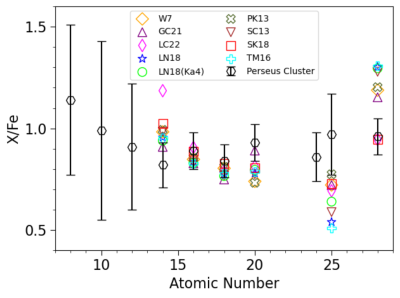
The observations showed levels of silicon, sulphur, argon, and calcium that simply did not match researchers understanding of how massive stars at least ten times the mass of the Sun live and die. This discrepancy signaled a need to completely rebuild the models of stellar evolution from the ground up.
A team of researchers, including The University of Tokyo Professor Emeritus and Kavli Institute for the Physics and Mathematics of the Universe (Kavli IPMU, WPI) Visiting Senior Scientist Ken'ichi Nomoto, Kavli IPMU Visiting Associate Scientist Shing-Chi Leung, and Netherlands Institute for Space Research Professor and Kavli IPMU Visiting Scientist Aurora Simionescu, has been working on the chemical abundances of Perseus Cluster measured by the X-ray Satellite HITOMI.
They published a sequence of papers in The Astrophysical Journal. The comprehensive multi-stage study first developed new models for massive stars that finally aligned with the specific chemical abundances (Si, S, Ar, and Ca) observed in the Perseus Cluster.
Then, the team expanded this work, creating a massive catalog of star models spanning a wide range of masses (15 to 60 solar masses) and "metallicities", the initial chemical makeup of a star dictated by its age in the universe. By processing this catalog through a galactic chemical evolution pipeline, they were able to reconstruct an over 10-billion-year history of how supernova feedback has shaped the chemical patterns we see today.
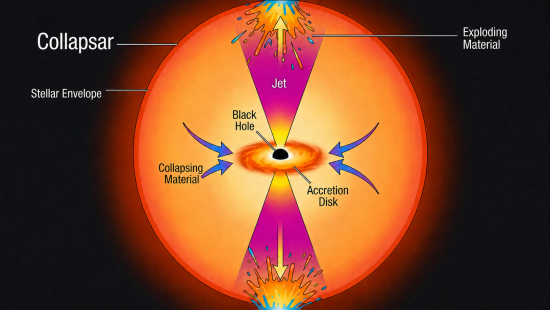
In the third paper, the team considered the extreme case where a supernova explodes in a bipolar jet form. This happens when the stars are rotating, which results in a rapidly rotating black hole (aka Collapsar) or neutron stars. The accretion disk around the compact remnants is subject to magneto-rotational instability, which results in a very energetic jet firing towards the remaining stellar envelope.
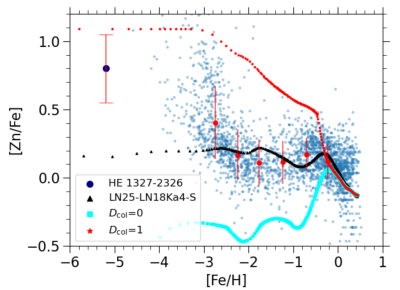
The team performed multi-dimensional simulations to trace how the jet triggered an outbreak and subsequent explosion. They discovered that its pronounced Zinc production could be the smoking gun for telling the fraction of these extreme events occurring in the past universe.
The team will continue to study how the models affect the chemical evolution of the Milky Way galaxy across history, from which they can further study the supernova demography and stellar population. The team is also interested in studying the upcoming data release from XRISM on various galactic clusters.
Paper Details
1. Journal: The Astrophysical Journal
Paper title: Revisiting the Perseus Cluster. I. Resolving the Si/S/Ar/Ca Ratios by Stellar Convection
Authors: Shing-Chi Leung (1), Ken’ichi Nomoto (2), Aurora Simionescu (3, 2, 4)
Author affiliations:
1 Department of Mathematics and Physics, SUNY Polytechnic Institute, 100 Seymour Road, Utica, NY 13502, USA
2 Kavli Institute for the Physics and Mathematics of the Universe (WPI), The University of Tokyo Institutes for Advanced Study, The University of Tokyo, Kashiwa, Chiba 277-8583, Japan
3 SRON Netherlands Institute for Space Research, Niels Bohrweg 4, 2333 CA Leiden, The Netherlands
4 Leiden Observatory, Leiden University, PO Box 9513, 2300 RA Leiden, The Netherlands
DOI: 10.3847/1538-4357/adf430 (published 9 September 2025)
Paper abstract (The Astrophysical Journal)
https://iopscience.iop.org/article/10.3847/1538-4357/adf430
Pre-print (arXiv.org) https://arxiv.org/abs/2507.21032
2. Journal: The Astrophysical Journal
Paper title: Revisiting the Perseus Cluster. II. Metallicity-dependence of Massive Stars and Chemical Enrichment History
Authors: Shing-Chi Leung (1), Seth Walther (1, 2, 3), Henry Yerdon (1, 2, 4), Ken’ichi Nomoto (5), Aurora Simionescu (5, 6, 7)
Author affiliations:
1 Department of Physics, SUNY Polytechnic Institute, 100 Seymour Road, Utica, NY 13502, USA; leungs@sunypoly.edu
2 Department of Electrical and Computer Engineering, SUNY Polytechnic Institute, 100 Seymour Road, Utica, NY 13502, USA
3 Department of Mathematics, SUNY Polytechnic Institute, 100 Seymour Road, Utica, NY 13502, USA
4 Department of Computer Science, SUNY Polytechnic Institute, 100 Seymour Road, Utica, NY 13502, USA
5 Kavli Institute for the Physics and Mathematics of the Universe (WPI), The University of Tokyo Institutes for Advanced Study, The University of Tokyo, Kashiwa, Chiba 277-8583, Japan
6 SRON Netherlands Institute for Space Research, Niels Bohrweg 4, 2333 CA Leiden, The Netherlands
7 Leiden Observatory, Leiden University, PO Box 9513, 2300 RA Leiden, The Netherlands
DOI: 10.3847/1538-4357/ae4979 (published 7 April 2026)
Paper abstract (The Astrophysical Journal) https://iopscience.iop.org/article/10.3847/1538-4357/ae4979
Pre-print (arXiv.org) https://arxiv.org/abs/2602.23354
3. Journal: The Astrophysical Journal
Paper title: Revisiting the Perseus Cluster. III. Role of Aspherical Explosions on Its Chemical Composition and Extension to Metal-poor Stars and Galaxies
Authors: Shing-Chi Leung (1), Henry Yerdon (1, 2, 3), Seth Walther (1, 2, 4), Ken’ichi Nomoto (5), Aurora Simionescu (5, 6, 7)
Author affiliations:
1 Department of Physics, SUNY Polytechnic Institute, 100 Seymour Road, Utica, NY 13502, USA; leungs@sunypoly.edu
2 Department of Electrical and Computer Engineering, SUNY Polytechnic Institute, 100 Seymour Road, Utica, NY 13502, USA
3 Department of Computer Science, SUNY Polytechnic Institute, 100 Seymour Road, Utica, NY 13502, USA
4 Department of Mathematics, SUNY Polytechnic Institute, 100 Seymour Road, Utica, NY 13502, USA
5 Kavli Institute for the Physics and Mathematics of the Universe (WPI), The University of Tokyo Institutes for Advanced Study, The University of Tokyo, Kashiwa, Chiba 277-8583, Japan
6 SRON Netherlands Institute for Space Research, Niels Bohrweg 4, 2333 CA Leiden, The Netherlands
7 Leiden Observatory, Leiden University, P.O. Box 9513, 2300 RA Leiden, The Netherlands
DOI: 10.3847/1538-4357/ae4d19 (published 7 April 2026)
Paper abstract (The Astrophysical Journal) https://iopscience.iop.org/article/10.3847/1538-4357/ae4d19
Pre-print (arXiv.org) https://arxiv.org/abs/2602.23356
Research Contact
Ken'ichi Nomoto
Visiting Senior Scientist
The University of Tokyo Kavli Institute for the Physics and Mathematics of the Universe (Kavli IPMU, WPI)
E-mail: nomoto_at_astron.s.u-tokyo.ac.jp
*Please change _at_ to @
Media Contact
Motoko Kakubayashi
Press officer
The University of Tokyo Kavli Institute for the Physics and Mathematics of the Universe (Kavli IPMU, WPI)
E-mail: press_at_ipmu.jp
* Please convert _a_ to @