
23 March 2026
The University of Tokyo Kavli Institute for the Physics and Mathematics of the Universe (Kavli IPMU, WPI)
Researchers find a shift in a key cosmic measurement in the early universe may be a statistical artefact, reports a recent study published in Physical Review D as an Editor’s Suggestion.
For the last few decades, researchers have been studying what the universe looked like in its first seconds. It is generally accepted the universe expanded exponentially in the first fraction of a second after the Big Bang.
Researchers use ns, the scalar spectral index, to characterize how primordial density fluctuations were distributed across different length scales in the early universe. The value of ns is a central observable in inflationary cosmology, since different inflationary scenarios predict distinct values for this quantity, making it a powerful discriminator between models. With the high-precision measurements from the Planck satellite, the scalar spectral index ns was thought to be tightly constrained. This measurement played a central role in shaping the landscape of viable inflationary models. As the precision ns improved, attention increasingly turned to other observables, such as the tensor-to-scalar ratio and primordial non-Gaussianities, as the next discriminants of inflationary physics. This was until 2025 when two groups of researchers combined different astrophysical datasets to come up with a value for ns that questioned some of the most famous models of inflation, bringing this parameter back to the center of the discussion.
However, a group of researchers led by the University of Tokyo Kavli Institute for the Physics and Mathematics of the Universe (Kavli IPMU, WPI) Project Assistant Professor Elisa Ferreira has now shown that this discrepancy arise originates from a subtle statistical interplay between measurements of the cosmic microwave background (CMB) and baryon acoustic oscillations (BAO), highlighting the role of dataset consistency in the inferred value of ns.
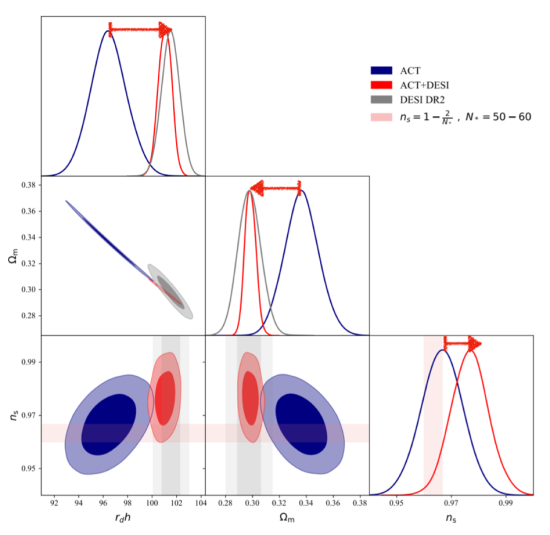
In the study, the team analyzed how combining BAO data with CMB observations affects the inferred value of the scalar spectral index ns. They showed that the shift in ns arises from a mild tension between these datasets — the “BAO–CMB tension” — which propagates into the inflationary parameter constraints. When this effect is properly accounted for, the evidence against standard inflationary models weakens significantly.
In particular, the authors demonstrate that the shift in ns is linked with changes in late-time cosmological parameters such as the matter density. This suggests the result does not primarily reflect new information about the physics of inflation, but rather internal dataset consistency. The study highlights the importance of carefully assessing cross-dataset tensions before drawing strong conclusions about fundamental early-universe models.
As a consequence, the inferred value of ns is not uniquely determined in the presence of the BAO-CMB tension. Different combinations of cosmological datasets lead to statistically significant shifts. Current constraints on inflation therefore depend sensitively on how late time data are incorporated.
Until the origin of this tension is clarified, it remains unclear which value of ns should be regarded as the most reliable. The shift may be due to unknown systematics, analysis choices, or potentially new physics.
Resolving this issue is essential before drawing firm conclusions about inflationary models and the physics of the early universe.
Paper details
Journal: Physical Review D
Paper title: BAO-CMB tension and implications for inflation
Authors: Elisa G. M. Ferreira (1,2), Evan McDonough (3), Lennart Balkenhol (4), Renata Kallosh (5), Lloyd Knox (6), and Andrei Linde (5)
Author affiliations:
1 Kavli IPMU (WPI), UTIAS, The University of Tokyo, 5-1-5 Kashiwanoha, Kashiwa, Chiba 277-8583, Japan
2 Center for Data-Driven Discovery, Kavli IPMU (WPI), UTIAS, The University of Tokyo, Kashiwa, Chiba 277-8583, Japan
3 Department of Physics, University of Winnipeg, Winnipeg Manitoba, R3B 2E9, Canada
4 Sorbonne Université, CNRS, UMR 7095, Institut d’Astrophysique de Paris, 98 bis bd Arago, 75014 Paris, France
5 Leinweber Institute for Theoretical Physics at Stanford, 382 Via Pueblo, Stanford, California 94305, USA
6 Department of Physics and Astronomy, University of California, Davis, California, 95616 USA
DOI : https://doi.org/10.1103/lq71-b84v (published 18 February 2026)
Paper abstract (Physical Review D)
Pre-print (arXiv.org)
Research Contact
Elisa Ferreira (English only)
Project Assistant Professor
The University of Tokyo Kavli Institute for the Physics and Mathematics of the Universe (Kavli IPMU)
E-mail:elisa.ferreira_at_ipmu.jp
* Please convert _a_ to @
Media Contact
Motoko Kakubayashi
Press officer
The University of Tokyo Kavli Institute for the Physics and Mathematics of the Universe (Kavli IPMU)
E-mail:press_at_ipmu.jp
* Please convert _a_ to @
Related links
Cosmic Inflation Confronts Dueling Data (Physics Magazine)