
September 30, 2026
The University of Tokyo Kavli Institute for the Physics and Mathematics of the Universe (Kavli IPMU, WPI)
Overview
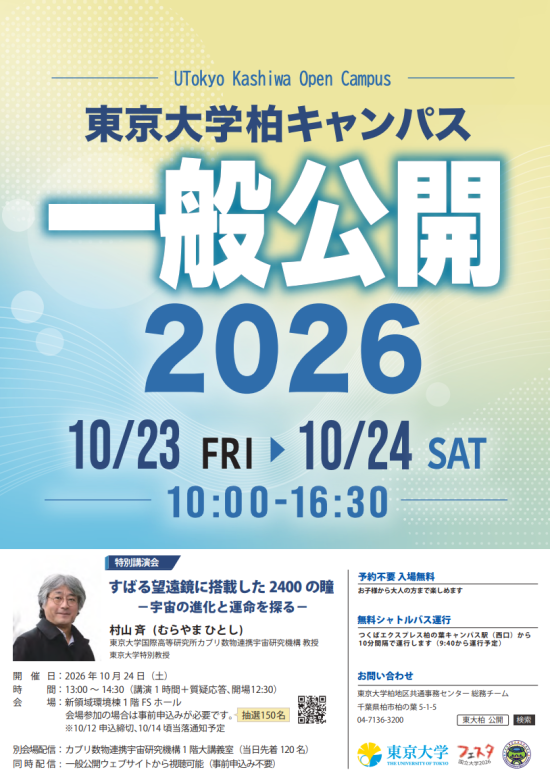
This coming October 23 (Fri) and 24 (Sat), The University of Tokyo Kashiwa Campus will host Kashiwa Open Campus
- TIME & DATE: 10:00am - 4:30pm, October 23 (Fri) and 24 (Sat)
- VENUE: The University of Tokyo Kashiwa Campus
- HOW TO ACCESS THE VENUE: A free shuttle bus will be available from Kashiwanoha Campus Station (Tsukuba Express line)
- ADMISSION: Free
- For more details, go to the University of Tokyo Kashiwa Open Campus 2026 website (Japanese and English)
* Please note, the car park within the campus will not be available. Please use public transport, the free shuttle bus, or bike (bike stands will be available).
Kavli IPMU Events
This year, some events will be streamed live online, and will be available to watch afterwards on archive until November 3.
* The live stream for each event is embedded in its section below. You can also watch them on our YouTube playlist.
Lecture: Exploring the Universe Using its Oldest Light
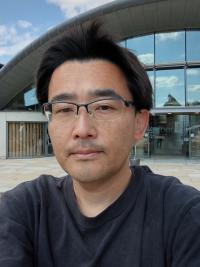
- Time & Date: 1:00pm - 2:00pm, October 23 (Fri)
- Venue: Lecture Hall (1F) (note: seats will be allocated on a first come, first serve basis. Once we have reached full capacity, we may not be able to allow any more people inside the venue)
*Note: This event will be recorded and available to watch on archive* - Speaker: Toshiya Namikawa
- Title: Project Associate Professor, Kavli Institute for the Physics and Mathematics of the Universe
- About This Talk:
How did the universe begin, and how did it become the way we see it today. A clue to finding an answer lies in the Cosmic Microwave Background (CMB), which was emitted approximately 380,000 years after the birth of the universe. The CMB is often referred to as the oldest light in the universe. It contains subtle fluctuations from the early universe, and studying it has uncovered numerous things about our universe, including its age, composition, and the origins of the structures that led to the formation of galaxies and stars.
Today, more advanced research is aiming to uncover what happened in the very early universe and will attempt to find new elementary particles or unknown physics hidden within it by detecting even fainter signals, such as the polarization of the CMB.
This lecture will begin by explaining what kind of light the CMB is, then introduce the current CMB maps researchers are able to observe, how to interpret the universe from them, and how far researchers will go to find answers to the mysteries of the universe.
Kashiwa Open Campus 2026 Special Lecture (Livestream Viewing): 2400 Eyes on the Sky: The Subaru Telescope's New View of the Cosmos
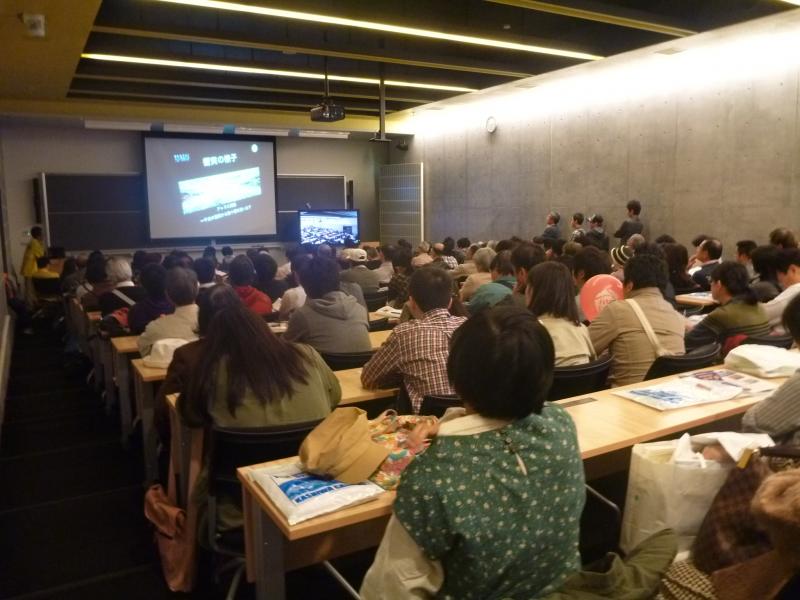
- Lecture duration: 90 minutes
- Time & Date: 1:00pm - 2:30pm, October 24 (Sat)
- Venue: Lecture Hall (1F) (note: seats will be allocated on a first come, first serve basis. Once we have reached full capacity, we may not be able to allow any more people inside the venue)
* This lecture is a livestream broadcast of the Special Lecture Professor Murayama is scheduled to give at the FS Hall on Kashiwa campus. By accessing the University of Tokyo Kashiwa Open Campus 2026 website you can also watch the livestream from your own smartphone/tablet/computer. Pre-registration is not required.
** Please note, if you wish to attend this lecture in person, pre-registration will be required.For more details, read and fill out a registration form here(deadline: October 12, and lottery winners will be announced on October 14)

- Speaker: Hitoshi Murayama
- Title: Kavli Institute for the Physics and Mathematics of the Universe Professor, University of Tokyo University Professor, Prime Focus Spectrograph Project Principal Investigator
- About This Talk:
How did the universe begin? How will it end? Why do we exist in the universe? For thousands of years, humans have had many questions about the universe and has continued to carry out research in an effort to uncover at least some of the answers. Today, we now know that about 95% of the universe, in other words, the vast majority of the universe is made up of an unidentified substance called dark matter, and unidentified force called dark energy that is causing the universe to expand at an accelerated rate. If researchers can identify and understand dark matter and dark energy, it will enable humans to see how the universe has evolved, and what fate lies ahead of it. To do this, researchers need to carry out a census of the night sky. Much like a census tells us about humans living on Earth, studying large numbers of galaxies and celestial objects across the sky will help uncover trends in the universe's evolution.One key to this process is spectroscopy, a technique that separates light into its constituent wavelengths for analysis. The newly installed Prime Focus Spectrograph (PFS, Hawaiian name: Ōnohiʻula) on the Subaru Telescope on Mauna Kea in Hawaii is the world’s most advanced instrument of its kind. Controlling 2400 optical fibers that act as eyes, the PFS can cover an area of the night sky equivalent to seven full moons. By capturing light from up to 2400 galaxies and celestial objects at once, the PFS divides the light's broad wavelength range into approximately 4000 colors that are then analyzed. Researchers came face to face with numerous challenges, but 15 year's after the project's inception, full-scale observations began in February 2025.
Thanks to the PFS, observations are being carried out at a speed unlike anything seen before, and we are on the verge of unraveling the nature of dark matter, the mysteries of dark energy, and even the evolution of galaxies. This lecture will go over the cutting edge of cosmic research being pioneered by the PFS’s 2400 eyes.
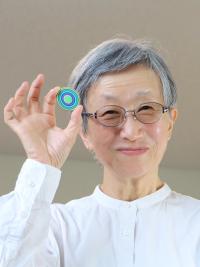
Science for Kids Lecture: How to Catch a Rainbow
- Time & Date: 11:00am - 11:40am, October 24 (Sat)
- Venue: Lecture Hall (1F) (note: seats will be allocated on a first come, first serve basis. Once we have reached full capacity, we may not be able to allow any more people inside the venue).
*Note: This event will be recorded and available to watch on archive*
- Speaker: Saeko Hayashi
- Title: Project Professor, Kavli Institute for the Physics and Mathematics of the Universe
- About This Talk:
Hello everyone, when was the last time you saw a rainbow? You may have noticed that rainbows appear across from the sun after it has stopped raining. Sometimes you can see them within a drop of water sitting on a leaf, or reflected in a puddle on the way to school. Why do we see rainbows, and how are they connected to the Sun? In this talk, we will use a small gadget that will help us see a rainbow, maybe even on your palm. Then we can start exploring what a rainbow is. The science behind a rainbow, is in fact very important to big science gadgets like the Subaru Telescope. The telescope doesn't study our Sun, but it is looking at the light from stars very far away from us. What can their light tell us? Join me in exploring objects far, far away in the universe! I will also share some of the latest news with you all.
SPARK! Ask an Overseas Scientist
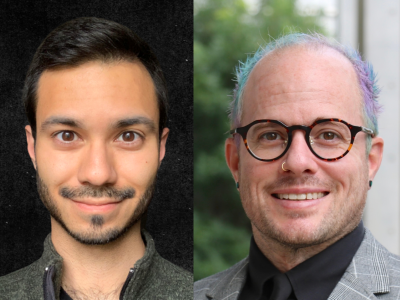
Overseas researchers at Kavli IPMU will talk about their research and life in Japan. This event will be in English.
- TIme & Date: 11:00am - Noon, October 23 (Fri)
- Speakers: Kavli IPMU Project Researchers Kevin McCarthy and Andrew Santos
- Venue: Lecture Hall (1F) (note: seats will be allocated on a first come, first serve basis. Once we have reached full capacity, we may not be able to allow any more people inside the venue). *This event will be recorded and available to watch on archive*
Science Onsen
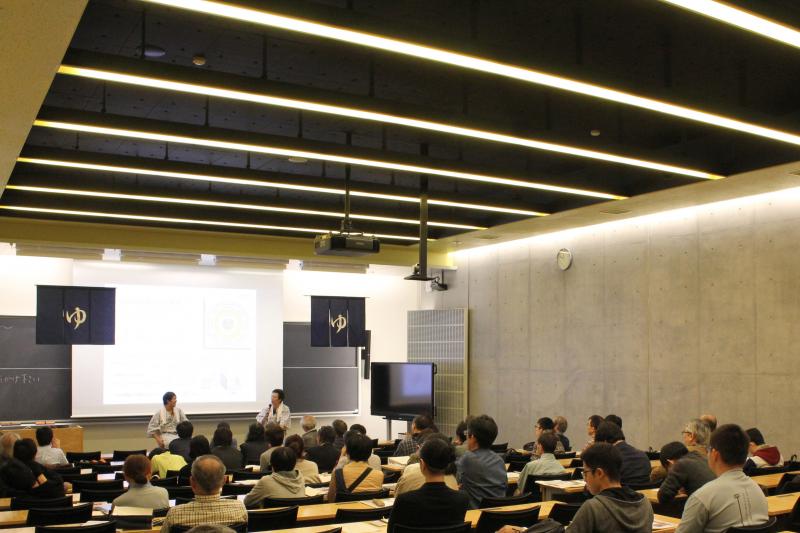
While "science cafes" began in England, we have adapted the concept and present a Japanese-style "science onsen" or "science hot spring".
- Time & Date: 3:30pm - 4:30pm, October 24 (Sat)
- Speakers: Kavli IPMU Project Researcher Keiichiro Furuya, The University of Tokyo Graduate School of Humanities and Sociology and Faculty of Letters Assistant Professor Teruhiko Sudo
- Venue: Lecture Hall (1F) (note: seats will be allocated on a first come, first serve basis. Once we have reached full capacity, we may not be able to allow any more people inside the venue). *This event will be recorded and available to watch on archive*
Mathematical flower arrangements!
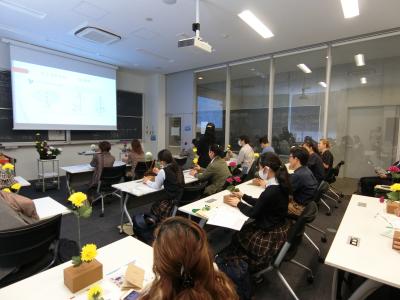
- Time & Date: 11:00am - Noon, October 24 (Sat)
- Venue: Seminar Room B, 1F
- Workshop is limited to 20 people. Tickets are available at the Kavli IPMU reception, and will be available from 10am on October 24 on a first come, first serve basis.
- Speaker: Yukari Ito
- Title: Kavli Institute for the Physics and Mathematics of the Universe Professor, Ohara School of Ikebana First Term Master
- About This Workshop:
Ikebana is a traditional Japanese art form, recreating the beauty of trees, plants, and flowers throughout the four seasons within the home. In this workshop, students will learn about ‘kata’ (standard form). These forms have been perfected over many years; they represent shapes that the Japanese find beautiful and can even be expressed mathematically. In this lecture, I will introduce the history of ikebana and its basic kata, and I hope you will enjoy an experiential exploration of “dimensions.”
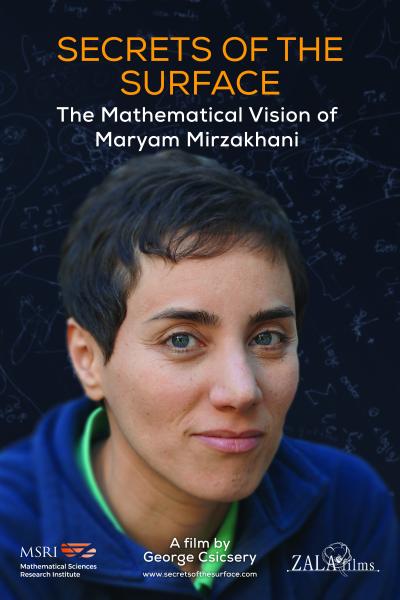
Film Screening: Secrets of the Surface: The Mathematical Vision of Maryam Mirzakhani
Often called the Nobel Prize of mathematics, the Fields Medal is awarded once every four years to a handful of mathematicians under 40 years of age. The award recognizes their outstanding contributions to the field, and their potential to continue to contribute to mathematics in the future. In 2014, Maryam Mirzakhani became the first woman and first Iranian to receive the award.
The film Secrets of the Surface is a documentary looking at Maryam's life and work in mathematics. The film looks at mathematics education in Iran, about what it's like to be a woman in the field of mathematics, and Maryam's impact on the field through her work. The film includes interviews with Maryam herself, and many friends and colleagues she has worked with over the years. (credit: zala films)
- Time & Date: 3:00pm - 4:00pm, October 23 (Fri)
- Venue: Lecture Hall (1F) (note: seats will be allocated on a first come, first serve basis. Once we have reached full capacity, we may not be able to allow any more people inside the venue). *This event will not be recorded nor be available to watch on archive*
Backstage Tour of Kavli IPMU
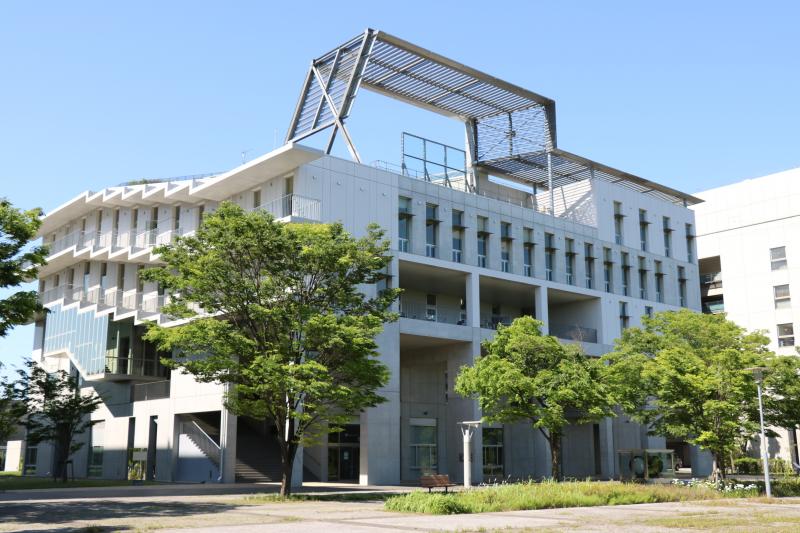
The award-winning design of the Kavli IPMU building has been praised for creating a home for scientists that allows people from different countries and different fields to get to know one another. Join one of our tours to get a behind-the-scenes look.
- Tour duration: 30 - 40 minutes
- Starting Time & Dates:
- October 23 (Fri): 11:00am, 12:30pm 2:30pm, 3:30pm
- October 24 (Sat): 11:00am, 12:30pm, 1:15pm, 2:00pm, 3:00pm, 3:45pm
- Where to sign up: Registration desk (1F)
- Each tour is limited to 20 people. Tickets are available at the Kavli IPMU reception.
*Note: 11am - 1:15pm tour tickets will be available from 10am on the day. 2pm - 3:45pm tour tickets will be available from noon on the day. All tickets will be distributed on a first come, first serve basis.
Peek inside a Kavli IPMU Laboratory!
We will open the doors to Kavli IPMU's Laboratory during open campus. Come and see what kind of research goes on.
- Time & Date: 10:00am - 4:30pm, October 23 and 24
- Venue: Laboratory B (1F)
Research at Kavli IPMU
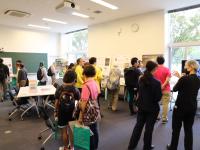
Have a look at the research Kavli IPMU researchers have been doing. Researchers and graduate students will be available to answer your questions about the universe.
- Time & Date: 10:00am - 4:30pm, October 23 (Fri) and 24 (Sat)
- Venue: Seminar Room A (1F)
*Other exhibits: A replica of the Hyper Suprime-Cam is located outside the Kavli IPMU building.
A photo take by the Hyper Supreme-Cam is on display on the 1F. The Belle II Experiment's Silicon Vertex Detector is on display on the 1F.
Kavli IPMU Stamp Rally
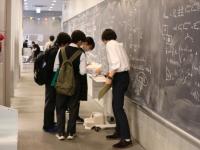
Stamp stations have been set up in different locations on the 1F, can you find all of them and complete the multi-layered picture?
- Time & Date: 10:00am - 4:30pm, October 23 (Fri) and 24 (Sat)
- Venue: Kavli IPMU building 1F
Make your own Magic Screen workshop
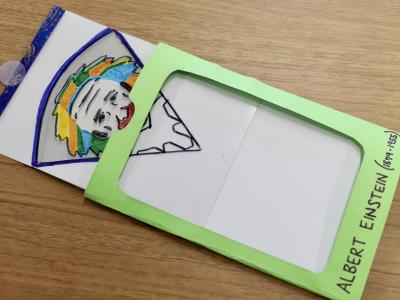
Draw your own drawing and watch it disappear and appear again!
- Duration: 30 minutes
- Time & Date:
- October 23(Fri): 11:30am, 2:00pm
- October 24(Sat): 1:00pm, 3:30pm
- Venue: Seminar Room B, 1F
- Each workshop is limited to 10 people. Tickets will be available at the Kavli IPMU reception from 10am on a first come, first serve basis.
*Note: This workshop is appropriate for elementary school children ages and above. Pre-elementary school children may also take part, but we ask that a caregiver also be present.
Mathematics Puzzle
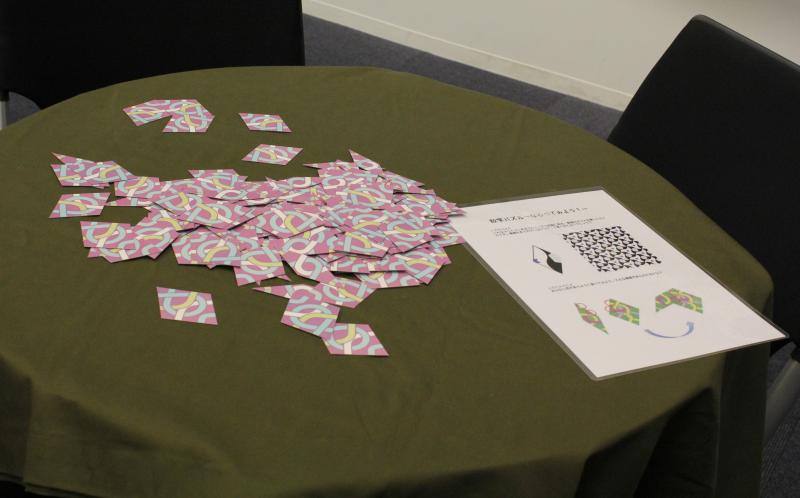
Have a go and see if you can cover an entire table top in puzzle pieces! What kind of patterns can you make out? Maybe you can come up with a mathematical explanation for it.
- Duration: 10 minutes
- Time & Date: 10:00am - 4:30pm, October 23 (Fri) and 24 (Sat)
- Venue: Seminar Room A (1F)