
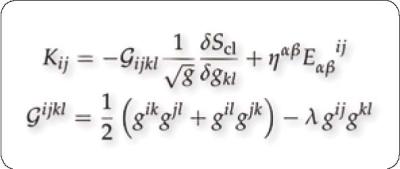
Einstein’s general theory of relativity describes gravity as the geometry of spacetime and has been remarkably successful in explaining a wide range of gravitational phenomena. More than a century after its formulation, it remains our standard theory of gravity. Yet some of the most fundamental questions in physics and cosmology arise precisely in regimes where our understanding of gravity is incomplete.
The direct detection of gravitational waves has opened a new window for testing gravity in the strong-field and dynamical regime. Observations of merging black holes and neutron stars allow us to explore gravity under extreme conditions that cannot be reproduced on Earth. Increasingly precise gravitational-wave observations, together with studies of black holes and other compact objects, provide powerful tests of general relativity and new opportunities to search for deviations from Einstein gravity.
At very short distances and extremely high energies, gravity must ultimately be reconciled with quantum mechanics. General relativity itself does not provide a complete quantum description of gravity. Theories beyond Einstein gravity may introduce new degrees of freedom, higher-order curvature terms, or even extra dimensions of space. Such possibilities arise naturally in attempts to construct a more fundamental theory of gravity, including string theory.
Gravity and the beginning of the Universe
The early Universe provides a particularly fascinating laboratory for exploring gravity at extremely high energies. According to the inflationary paradigm, the Universe underwent a period of accelerated expansion in its very early stage. Quantum fluctuations generated during inflation are believed to have provided the seeds from which galaxies and the large-scale structure of the Universe eventually formed.
Interestingly, some of the most successful and widely studied models of inflation are intimately connected with extensions of Einstein gravity. Starobinsky inflation is driven by an R2 correction to the Einstein action, while Higgs inflation introduces a non-minimal coupling between the Higgs field and gravity. Although these models have different theoretical origins, they give closely related predictions for the primordial cosmological perturbations.
Thus, modified gravity is relevant not only as a possible description of gravity under extreme conditions, but also as a framework for understanding the very beginning of our Universe. Measurements of the cosmic microwave background, large-scale structure, and primordial gravitational waves may enable us to distinguish among inflationary models and probe the nature of gravity at energy scales far beyond those accessible by terrestrial experiments.
Gravity and the accelerating Universe
Remarkably, accelerated expansion is not confined to the beginning of cosmic history. Observations show that the present Universe is also undergoing accelerated expansion. Within general relativity, this acceleration is usually attributed to dark energy, whose nature remains one of the greatest mysteries in modern physics.
This raises a fundamental question: are the two periods of accelerated expansion—the inflationary Universe and the present dark-energy-dominated Universe—telling us something profound about gravity?
The observed cosmic acceleration may be caused by new forms of matter or energy within general relativity, or it may indicate that gravity itself behaves differently on cosmological scales. Modified theories of gravity can introduce characteristic changes in the expansion history of the Universe, the growth of cosmic structure, gravitational lensing, and the propagation of gravitational waves. These signatures make it possible to test gravity observationally over enormous distances and timescales.
Testing gravity across cosmic scales
The rapid development of observational cosmology has transformed modified gravity from a largely theoretical subject into one that can be tested with precision data. Measurements of the cosmic microwave background, galaxy clustering, gravitational lensing, and gravitational waves allow us to examine different aspects of gravity and to search for departures from general relativity.
At Kavli IPMU, we study gravity across an extraordinary range of scales—from fundamental theories of gravity and the very early Universe to black holes, gravitational waves, the formation of cosmic structure, and the accelerating Universe. We develop theoretical models, identify their observable signatures, and confront them with data from current and future cosmological and gravitational-wave observations.
By bringing together particle physics, cosmology, astrophysics, and observations, we aim to understand why Einstein’s theory works so well, where it might eventually break down, and what a more fundamental theory of gravity could tell us about both the beginning and the future of our Universe.
(Last update: 2026/09/10)
Members
- Robert Brandenberger
- Otavio Freire Alves
- Tomohiro Fujita
- Rodrigo Gonzalez Quaglia
- Anamaria Hell
- Benjamin Horowitz
- Kazunori Kohri
- Kazuya Koyama
- Thomas (Tom) Melia
- Shinji Mukohyama
- Yasunori Nomura
- Misao Sasaki
- Yevgeny Stadnik
- Masahiro Takada
- Atsushi Taruya
- Edwin Turner
- Mianqi Wang
- Marcus Werner
- Vicharit Yingcharoenrat
- Jun'ichi Yokoyama