

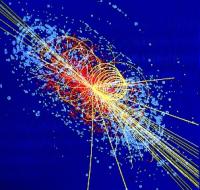
The Large Hadron Collider (LHC) at CERN investigates the elementary particles that make up matter and the forces acting between them through proton collisions at the world’s highest energies. Researchers at Kavli IPMU bring together theoretical predictions and the vast amounts of data collected by the LHC experiments to test the Standard Model of particle physics with precision and explore new physics beyond it.
The discovery of the Higgs boson at the LHC in 2012 marked a major advance in our understanding of how elementary particles acquire mass. Yet important questions, including the nature of dark matter, remain unanswered by the Standard Model. Although the LHC experiments have not yet established evidence for new particles or phenomena beyond the Standard Model, measurements of Higgs boson properties and searches for new particles provide crucial guidance for testing new theories and shaping future searches. At Kavli IPMU, researchers study dark matter candidates and ideas such as supersymmetry, while also exploring a broad range of possibilities without restricting their searches to specific theoretical models.
An important direction in the search for new physics is to make use of signals that have traditionally been difficult to detect. A deeper understanding of the detectors, together with advances in particle-track reconstruction and data analysis, is enabling searches to make broader use of low-momentum particle tracks and tracks from particles produced away from the collision point. These signals open up opportunities to explore a wider range of new physics, including particles that conventional searches could easily miss and long-lived particles that travel some distance before decaying.
Precise theoretical predictions are essential for taking full advantage of experimental sensitivity. Researchers at Kavli IPMU perform detailed calculations of signals from dark matter candidates and other new particles, incorporating quantum corrections. By predicting signal rates and characteristics more accurately and assessing their uncertainties, they enable more reliable comparisons between theory and experiment and strengthen the search for new physics.
Alongside searches for new particles, we study phenomena that fall within the Standard Model but whose theoretical predictions remain subject to substantial uncertainties. In particular, we carry out theoretical studies to identify which measurements and analyses at collider experiments would best help refine predictions for the production rates of nuclei such as deuterons and their antimatter counterparts, as well as their interactions with matter. Through this work, we aim to deepen our understanding of quantum chromodynamics (QCD), the theory of the strong force, and the formation and interactions of nuclei, thereby improving theoretical predictions in cosmic-ray physics. This research also provides a theoretical foundation for more accurate estimates of signals and backgrounds in indirect searches for dark matter, including those that look for antinuclei produced by dark matter annihilation or decay.
At the Belle II experiment at Japan’s SuperKEKB accelerator, we explore opportunities to probe new physics through precision measurements. Detailed studies of phenomena involving different types, or “flavors,” of quarks and leptons provide tests of the Standard Model and ways to search for indirect signs of new physics. We also discuss possibilities for investigating quantum entanglement and correlations between particles, bringing perspectives from quantum information to the study of elementary particles. Kavli IPMU hosts a research group participating in Belle II, and regular exchanges with experimental researchers offer a valuable opportunity to develop theoretical ideas into concrete proposals for measurements and analyses.
The physics opportunities at future colliders are also a major research theme. We study prospects for the High-Luminosity LHC, which will collect substantially larger datasets, as well as proposed electron?positron colliders such as FCC-ee and the International Linear Collider (ILC). These studies investigate the potential for precision measurements of the Higgs boson and other particles, along with searches for new particles. Looking further ahead, we also pursue theoretical studies of dark matter searches and Higgs boson properties at a future muon collider, which would bring beams of muons into collision.
These efforts benefit from Kavli IPMU’s interdisciplinary research environment. Active exchanges among researchers in particle theory and experiment, dark matter searches, cosmology, and related fields allow us to combine insights from accelerator experiments and observations of the Universe to investigate the fundamental laws of nature.
(Last update: 2026/09/25)