
July 22, 2026
The University of Tokyo Kavli Institute for the Physics and Mathematics of the Universe (Kavli IPMU, WPI)
An international team of researchers have found when primordial black holes triggered white dwarf stars to explode as Type Ia supernovae, it may have caused a chemical abundance trend, reports a recent study published in The Astrophysical Journal on June 20.
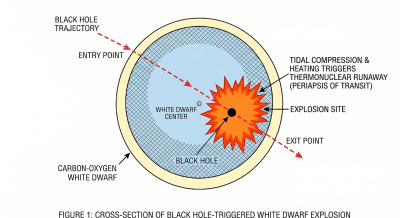
Primordial black holes (PBH) are one of the relics from the primordial universe. During the inflation period, the primordial fluctuation of matter in the created PBHs. These black holes could be a candidate to explain the mysterious dark matter, the invisible matter that contributes to about 90% of matter in the Universe by mass. These PBHs could pass through stars across the universe. Early works suggest that, during their passage, the tidal interaction due to their own gravity could trigger the white dwarfs, a stellar evolutionary end point for low-mass stars, to explode as Type Ia supernovae (SNe Ia).
A team of researchers led by SUNY Polytechnic Institute Assistant Professor and The University of Tokyo Kavli Institute for the Physics and Mathematics of the Universe (Kavli IPMU) Visiting Associate Scientist Shing-Chi Leung, and including Kavli IPMU Visiting Senior Scientist Ken'ichi Nomoto and Kavli IPMU Senior Fellow Alexander Kusenko, studied the dynamical, optical, and chemical characteristics of supernovae under this new PBHs-triggered explosion channel.
In an earlier paper published in 2025 by the team, the PBH-triggered explosions can actually produce SNe Ia that closely resemble the standard SNe Ia models.
In this new study, the researchers did a comparative study with supernova remnants (Tycho, Kepler, 3C 397), nearby supernovae (e.g., SN 2011fe, SN 2012cg) and the chemical abundances of Milky Way stars. They showed PBH-triggered SNe Ia could explain several observed characteristics of these objects. By examining the radioactive isotopes such as Ni-56, Ni-57, and stable elements such as Mn and Ni, the team pinned down the masses and the metallicities (the amount of metal when the star is formed, which probes when the star is born in the cosmic age) of the progenitor stars of these supernova events and remnants.
Furthermore, the supernova model to study how this explosion channel was involved in the galactic chemical enrichment showed that a non-zero fraction of PBH-triggered SN Ia is necessary to explain the chemical abundance trend made by stars in the Milky Way.
“Our work suggests that some supernova that we observe in the sky could be a result of the PBHs. Therefore, even though we cannot directly observe these evasive entities, they leave many interesting clues in nature for us to probe their properties.” Leung said.
The team will continue to expand the research scope to study how these supernovae change the population of canonical supernovae and the collective rates of these transient events.
Paper details
Journal: The Astrophysical Journal
Paper title: Primordial Black Hole Triggered Type Ia Supernovae II: Comparison with Supernova Remnants and Galactic Chemical Evolution
Authors: Shing-Chi Leung (1, 5), Seth Walther (1, 2, 3), Alexander Kusenko (4, 5), Ken’ichi Nomoto (5), Tomoharu Suzuki (6)
Author affiliations:
1 Department of Physics, SUNY Polytechnic Institute, 100 Seymour Road, Utica, NY 13502, USA; leungs@sunypoly.edu
2 Department of Mathematics, SUNY Polytechnic Institute, 100 Seymour Road, Utica, NY 13502, USA
3 Department of Electrical and Computer Engineering, SUNY Polytechnic Institute, 100 Seymour Road, Utica, NY 13502, USA
4 Department of Physics and Astronomy, University of California, Los Angeles California, 90095-1547, USA
5 Kavli Institute for the Physics and Mathematics of the Universe (WPI), The University of Tokyo Institutes for Advanced Study, The University of Tokyo, Kashiwa, Chiba 277-8583, Japan
6 School of General Education, Chubu University, 1200 Matsumoto-cho, Kasugai, Aichi 487-8501, Japan
DOI: 10.3847/1538-4357/ae6db7 (published June 20, 2026)
Paper abstract (The Astrophysical Journal のページ)
Pre-print (arXiv.org)
Related links
SUNY Poly Researchers Explore Supernova Origins Through Primordial Black Holes
“Primordial Black Hole Triggered Type Ia Supernovae. I. Impact on Explosion Dynamics and Light Curves”, The Astrophysical Journal 991, 11 (2025)
arXiv: https://arxiv.org/abs/2507.21041
ApJ: https://iopscience.iop.org/article/10.3847/1538-4357/adf4e8
Related articles
Researchers Uncover Chemical Origins of the Perseus Cluster of Galaxies (May 14, 2026)
A rogue in the “Cosmic Standard Candle”? - the relic of the densest white dwarf has been detected in the remnant of its supernova - (June 10, 2021)
Simulations uncover why supernova explosions of some white dwarfs produce so much manganese and nickel (September 21, 2018)