
November 11, 2026
The University of Tokyo Kavli Institute for the Physics and Mathematics of the Universe (Kavli IPMU, WPI)
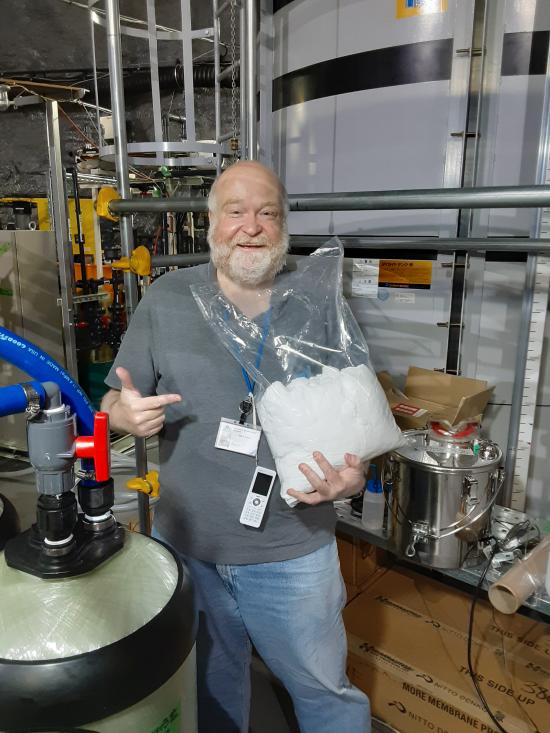
The University of Tokyo Kavli Institute for the Physics and Mathematics of the Universe (Kavli IPMU, WPI) Professor and Deputy Director Mark Vagins has been named this year’s recipient of the DPF Instrumentation Award, announced the American Physical Society (APS) Division of Particles & Fields on October 23.
The DPF Instrumentation Award was established in 2015 by the APS to honor exceptional contributions to instrumentation advancing the field of particle physics through the invention, refinement, or application of instrumentation and detectors.
Vagins is being recognized “for pioneering the conception and realization of gadolinium-loaded water Cherenkov detectors, enabling efficient neutron tagging and opening new opportunities in neutrino and dark-matter physics.”
Water Cherenkov detectors, such as Super-Kamiokande and IceCube, work by imaging electrically charged particles like electrons, muons, and protons, whose high-speed passage through water produces cones of light that photomultiplier tubes then collect.
For decades, these detectors have been used successfully to study neutrinos, whose rare interactions with water molecules generate fast charged particles and, in turn, Cherenkov light. The disadvantage is that electrically neutral neutrons produce no Cherenkov light and are therefore difficult to detect.
Adding gadolinium (Gd) to the water addresses this challenge, because gadolinium captures neutrons very efficiently and emits easily detected flashes of light when it does so. Gd-loaded detectors provide much more final-state information than pure-water detectors, enabling more sensitive studies of neutrinos, proton decay, and backgrounds to dark matter searches. This is why the technique has been adopted by many experiments worldwide and has already produced world-leading results, with more unique measurements to come.
“Since originating the Gd-loaded water idea with my theorist friend, Ohio State University professor John Beacom in 2002, as an experimentalist I have spent the past quarter century focused on working out the technology and equipment needed to make the idea actually work. This APS Instrumentation Award is an acknowledgement of over two decades of effort by me and many others in Japan, the US, and elsewhere who helped me bring the concept to fruition. It is an honor to be recognized in this fashion. Now we have to get gadolinium into Hyper-Kamiokande,” said Vagins.
Vagins was awarded his prize on the final day of the Coordinating Panel on Advanced Detectors workshop at the University of Washington in the US.
Related links
About the DPF Instrumentation Award (APS)