

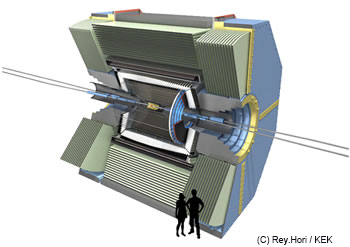
The Belle II experiment at SuperKEKB is dedicated to exploring the flavor sector of the Standard Model by precisely measuring the decays of B/D mesons and τ leptons. By improving measurement precision by an order of magnitude, Belle II aims to uncover hints of new physics beyond the Standard Model.
SuperKEKB is an energy-asymmetric electron-positron collider, designed to produce an exceptionally high number of B meson pairs and τ lepton pairs. It achieves a luminosity approximately 30 times greater than its predecessor, KEKB. Following careful optics tuning of the electron and positron beams and commissioning of the accelerator-detector integrated system, SuperKEKB successfully achieved its first collisions in April 2018, with Belle II detecting signals from the resulting interactions.
The Belle II detector is an upgraded version of the predecessor Belle detector, designed to take full advantage of SuperKEKB’s high-luminosity performance. The Kavli IPMU group played a leading role in mass-producing modules (called ladders) of the silicon vertex detector (SVD), which precisely measures the position of charged particles produced by the SuperKEKB accelerator. The SVD ladder mass-production required highly advanced technologies, including alignment of silicon sensors with a 100-micron precision, control of adhesive spread to under 1 mm, and wire bondings over 10,000 electrical connections with 25-micron wires between readout ASICs and the SVD sensors. Through maintaining consistent ladder quality across a two-year mass-production period, the Kavli IPMU team successfully completed the mass production of equally qualified SVD ladders in May 2018, which was a major achievement by the group. After being delivered to KEK in Japan, the ladders were integrated with another vertex detector of Belle II and installed into the Belle II detector in November 2018. Full-scale physics data-taking began on March 25, 2019.
The Kavli IPMU group is trying to search for new sources of CP violation beyond the Standard Model, which is key to understanding why the universe is dominated by matter rather than antimatter, using the Belle II dataset. They are also looking for particle decays with potential dark matter candidate particles involved and testing the principles of quantum mechanics in the B meson system. Looking to the future, they are preparing for a major upgrade of the Belle II detector’s vertex system, scheduled for the early 2030s.
(Last update: 2026/08/28)
Links
- Heavy Flavor Physics
- Models Beyond the Standard Model
- Detector/Instrument Development
- Belle II Homepage
News
- Belle II explores new "portal" into dark matter - First results from the Belle II Experiment (Apr 7, 2020)
- Upgraded SuperKEKB accelerator will start taking data (Mar 12, 2019)
- Inner component of Japan’s upgraded particle accelerator nears completion (May 28, 2018)
- Electrons and Positrons collide for the first time in the SuperKEKB Accelerator (Apr 26, 2018)
- SuperKEKB accelerator kicks into a new gear (Mar 23, 2018)
- Kavli IPMU joins Belle II experiment (Nov 21, 2012)